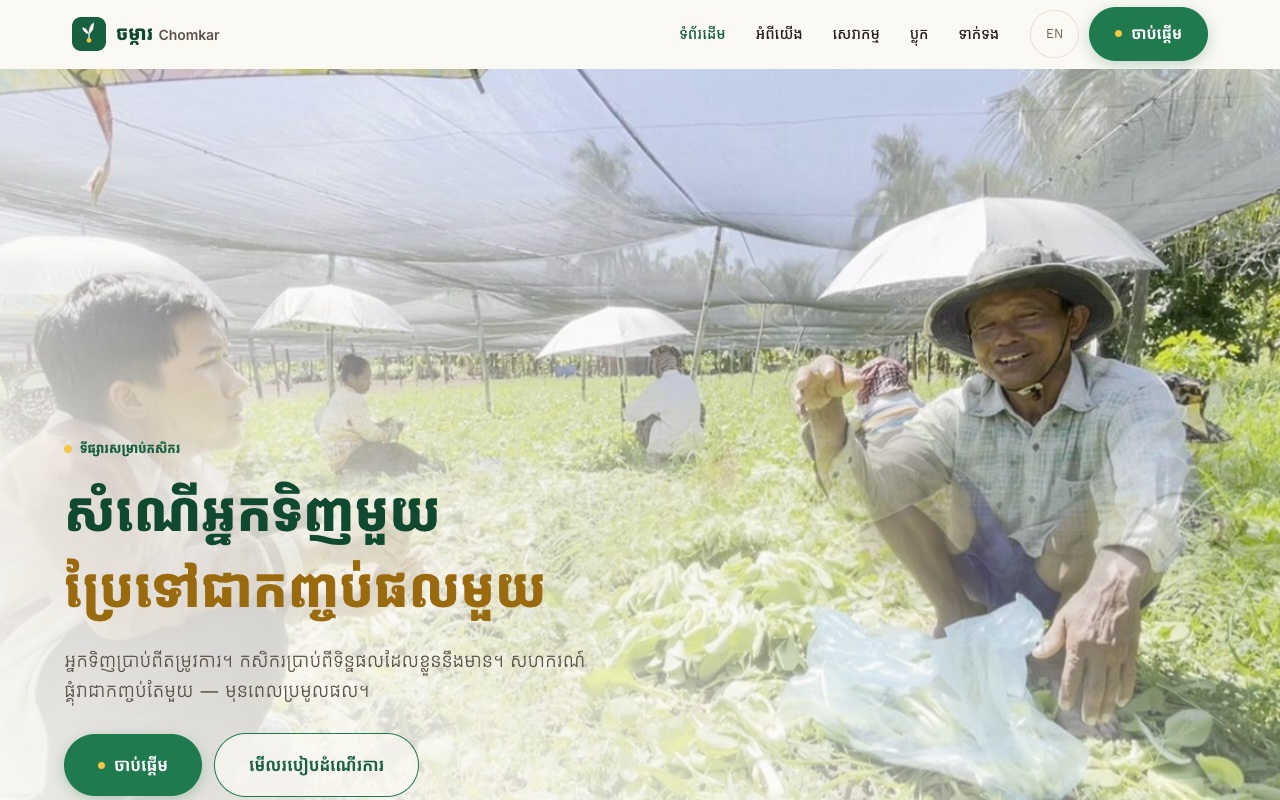
Chomkar.com
Agritech platform focused on market access for Cambodian farmers
What this proves
I can carry a real product end to end — problem framing, an edge backend, third-party AI integration, and offline UX — while reasoning carefully about failure modes, secret handling, and honest product claims instead of overstating what the system does.
Problem
Smallholder farmers often struggle to connect supply with buyer demand at the right time. The problem is not only posting crops online; it is coordination, demand visibility, trust, and clearer pre-harvest information.
My role
I co-founded and helped shape the project direction, contributed as a full-stack engineer, worked on product strategy and user flow, supported buyer and farmer flow design, helped prepare the pitch deck and demo flow, and worked on positioning the project for hackathon judging and startup validation.
What I built
- — A market-access product direction for farmer supply and buyer demand.
- — Farmer and buyer flow planning.
- — Full-stack product contributions during the build.
- — Pitch deck support, demo flow preparation, and business model explanation.
- — Project positioning from KasekorX AI voice-to-marketplace into Chomkar.com.
Architecture
The deployed system is deliberately DB-free at the edge: a static Khmer-first site plus a dependency-free hash-router PWA (farmer, operator, buyer, and verify views) backed only by Cloudflare Pages Functions, so the whole app stays offline-capable and cheap to run. The one live AI surface — a lesson helper on Claude Haiku with an optional ElevenLabs voice-to-text — is walled off from commerce by a two-layer guard, and commercial state is driven by an explicit multi-step spine where confirmed availability is never conflated with a sale. Voice was split into its own Worker after a multipart upload crashed the Pages runtime, and the service worker uses network-first-with-cache-reload so deploys are never hidden behind a stale edge cache.
The product focuses on connecting farmer supply with buyer demand through better coordination, clearer crop information, pre-harvest demand visibility, and a trust-focused supply flow.
Backend / deployment
- Status
- Deployed
- Frontend
- Static Khmer-first site + dependency-free hash-router PWA with an offline service worker
- Backend
- Cloudflare Pages Functions (/api/ask, /api/transcribe, /api/health) + a standalone Khmer-voice Worker
- Database
- None in the deployed app yet (commerce state uses in-memory / localStorage demo data)
- Hosting
- Cloudflare Pages, custom domain chomkar.com; AI routed through a Cloudflare AI Gateway
Live at chomkar.com — Cloudflare Pages + edge Functions (AI helper, Khmer voice). Commerce state still demo/in-memory as the product matures.
Backend-adjacent proof
- — Cloudflare Pages Functions serving POST /api/ask, POST /api/transcribe, and GET /api/health.
- — Server-side secret handling: Anthropic and ElevenLabs keys live only in the Pages environment; a missing key degrades gracefully instead of failing.
- — Per-isolate token-bucket rate limiting on the AI endpoint, with upstream failures coerced to a fixed Khmer escalation so a raw error never reaches a farmer.
- — A standalone Khmer-voice Worker doing manual multipart byte-assembly for the speech upload, routed through a Cloudflare AI Gateway to satisfy egress rules.
- — A whitelist deploy script with leak-guards that abort if any private file reaches the staging directory.
Stack
Constraints
- — Built under hackathon pressure with a startup-style judging format
- — Needed to explain a Cambodia-relevant agriculture problem clearly
- — Had to connect product flow, business model, pitch, and demo into one story
- — Still an active student-built product, so public claims must stay honest
Tradeoffs
- — Focused the pitch around market access instead of trying to solve every agriculture problem at once.
- — Kept the product explanation practical so farmers, buyers, and judges could understand the flow.
- — Treated the hackathon result as validation, not as proof that the product is finished.
What It Demonstrates
- Top 2 — Turing Hackathon Cycle 10.
- Theme: Market Access for Farmers.
- Project evolution: KasekorX AI voice-to-marketplace → Chomkar.com.
What I learned
- — How to frame a local agriculture problem as a product problem.
- — How to connect user flow, technology, business model, and pitch narrative.
- — How hackathon pressure forces simple product decisions.
- — How team collaboration changes the way a product grows.
- — Why agritech trust, coordination, and timing matter as much as the interface.
Next backend step
Add a durable persistence and auth layer behind the edge Functions — a hosted Postgres plus real cooperative and buyer accounts — as I move toward the hosted-backend cloud work I am actively studying.
Next steps
- — Keep improving the farmer and buyer flows.
- — Add stronger public proof with screenshots, photos, and event documentation.
- — Continue validating the product direction beyond the hackathon.
Working on something similar?
Let's talk →