
Top 2 Hackathon Project2026Co-founder · Product Builder · Full-stack Engineer
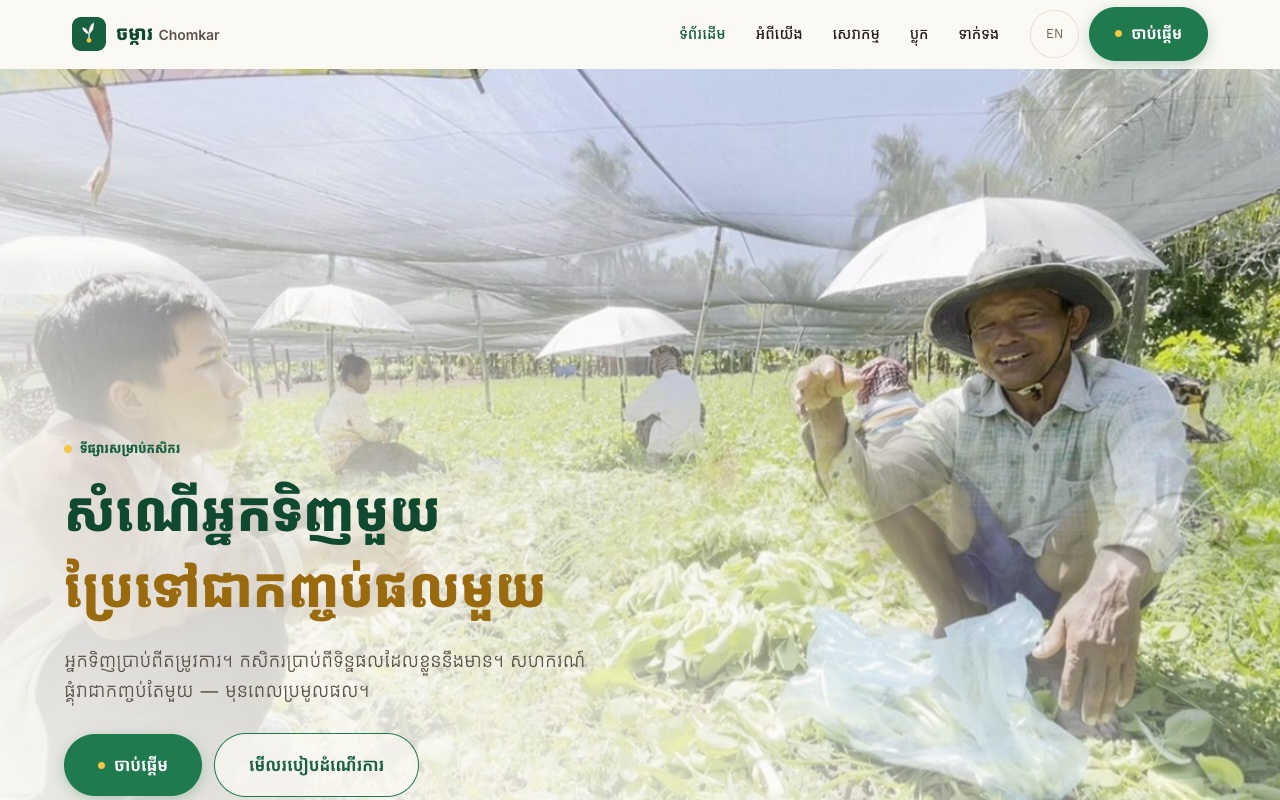
Smallholder farmers in Cambodia lose value not from a lack of listings but from weak coordination — buyer demand, pre-harvest visibility, and trust rarely line up in time. Chomkar.com is a Khmer-first, offline-capable market-access product that models that full loop, with a live Cloudflare edge backend powering a claim-safe AI lesson helper and Khmer voice-to-text. It is my strongest current proof: a real Cambodia problem carried from framing to a deployed build, with strict honesty about what the software actually promises.
Proof- Top 2 at Turing Hackathon Cycle 10 (theme: Market Access for Farmers).
- Live edge backend: Cloudflare Pages Functions (/api/ask, /api/transcribe, /api/health) with API keys held server-side, never on the device.
- Two-layer claim-safety firewall: a Khmer/English keyword guard blocks price/sale/certification topics before any AI call, then a lesson-scoped prompt escalates anything off-lesson to a human.
DeploymentLive at chomkar.com — Cloudflare Pages + edge Functions (AI helper, Khmer voice). Commerce state still demo/in-memory as the product matures.
Cloudflare PagesPages FunctionsCloudflare WorkersVanilla JS PWAAnthropic API+3
View case study →Private Phase 02026Founder-engineer
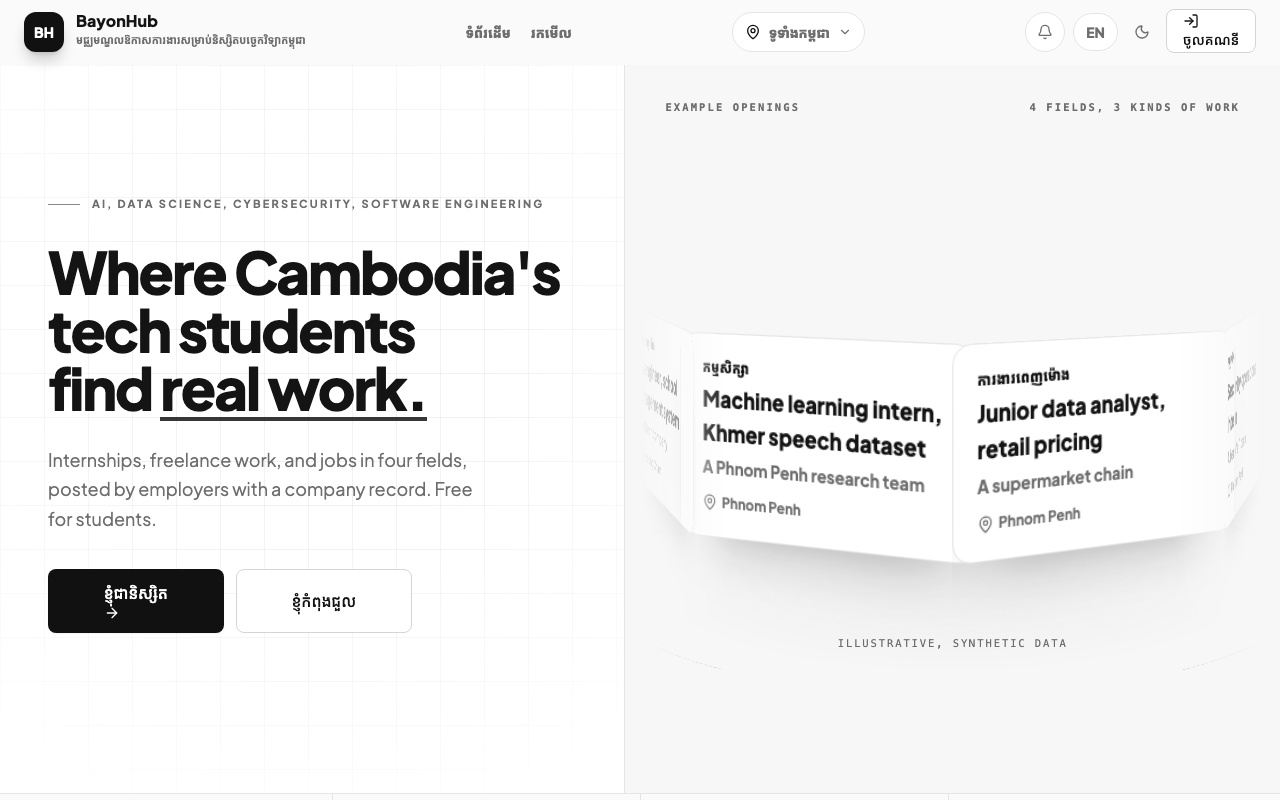
Cambodian students in AI, data science, cybersecurity, software engineering, and related fields need one focused path to internships, freelance work, jobs, and portfolio-building opportunities. BayonHub is being rebuilt around that path. The merged Phase 0 establishes the student, employer, and admin trust boundaries; opportunity discovery and applications remain under review rather than being presented as shipped.
Proof- Role-aware STUDENT, EMPLOYER, and ADMIN accounts, with student profiles and company records created transactionally during registration.
- Opportunity, saved-opportunity, and application models designed around historical application snapshots so submitted evidence survives later record changes.
- A documented offline boundary: synthetic read-only previews may degrade gracefully, while consequential writes must fail clearly when no employer can receive them.
DeploymentPrivate product build. Phase 0 is merged and verified; the student opportunity and application experience is still a reviewed draft, and no production launch is claimed.
React 19ViteTypeScriptExpress 5Prisma+3
View case study →Full-stack build2026Solo full-stack design & engineering
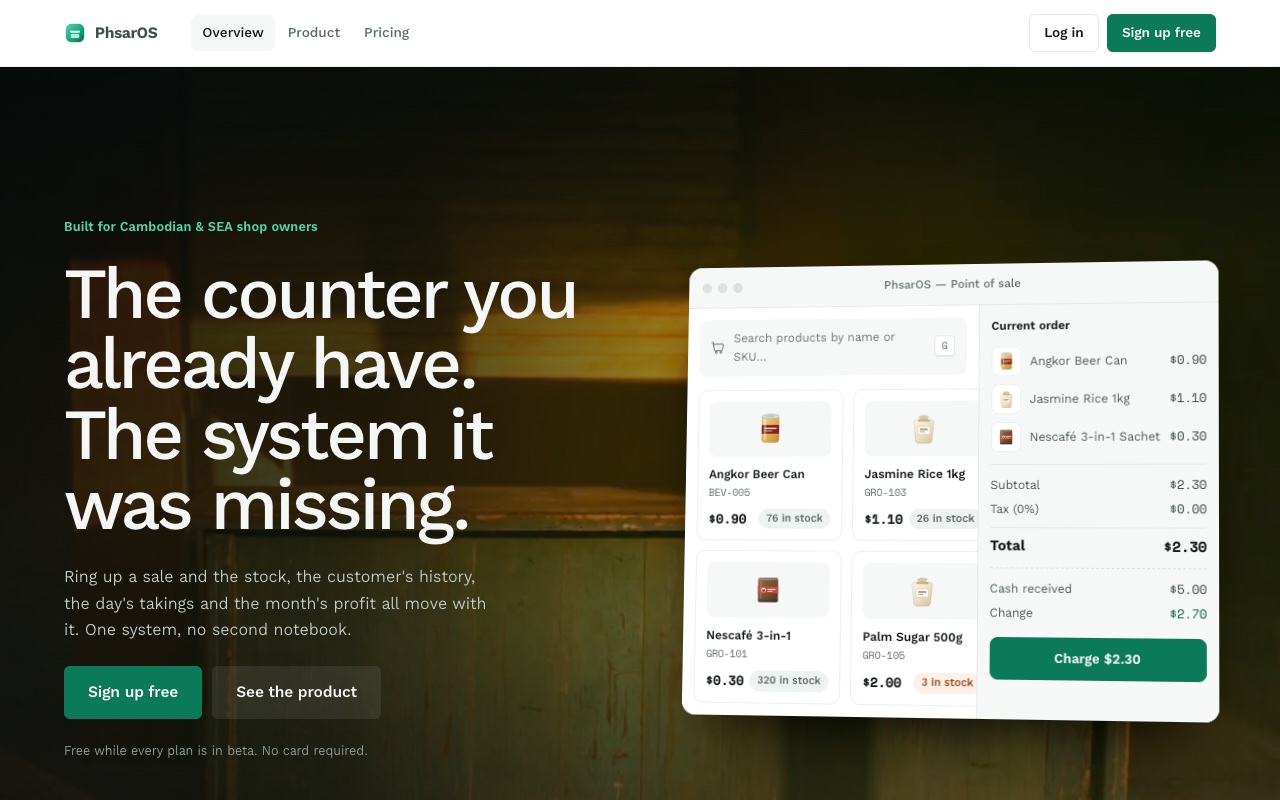
Small retailers often fall back to pen and paper because existing point-of-sale tools are slow, complex, or hardware-heavy. PhsarOS is a full-stack POS and operations dashboard where the hard part lives on the server: checkout runs as a single atomic Prisma transaction across a seven-model relational schema, every mutation is Zod-validated, and the dashboard renders the day's numbers server-side. It is my clearest evidence of reasoning about data integrity and backend flow, not just building screens.
Proof- Atomic checkout: sale + sale items + stock decrement committed in one Prisma transaction.
- Prisma 7 + Neon Postgres relational schema (7 models) behind 7 application routes.
- Server-side Zod validation on every mutation via type-safe Server Actions.
DeploymentBuilt on Vercel + Neon Postgres + Prisma server actions; the hosted demo instance is currently being fixed.
Next.js 14React Server ComponentsServer ActionsTypeScriptPrisma 7+5
View case study →Private Launch Candidate2026Product builder and full-stack engineer
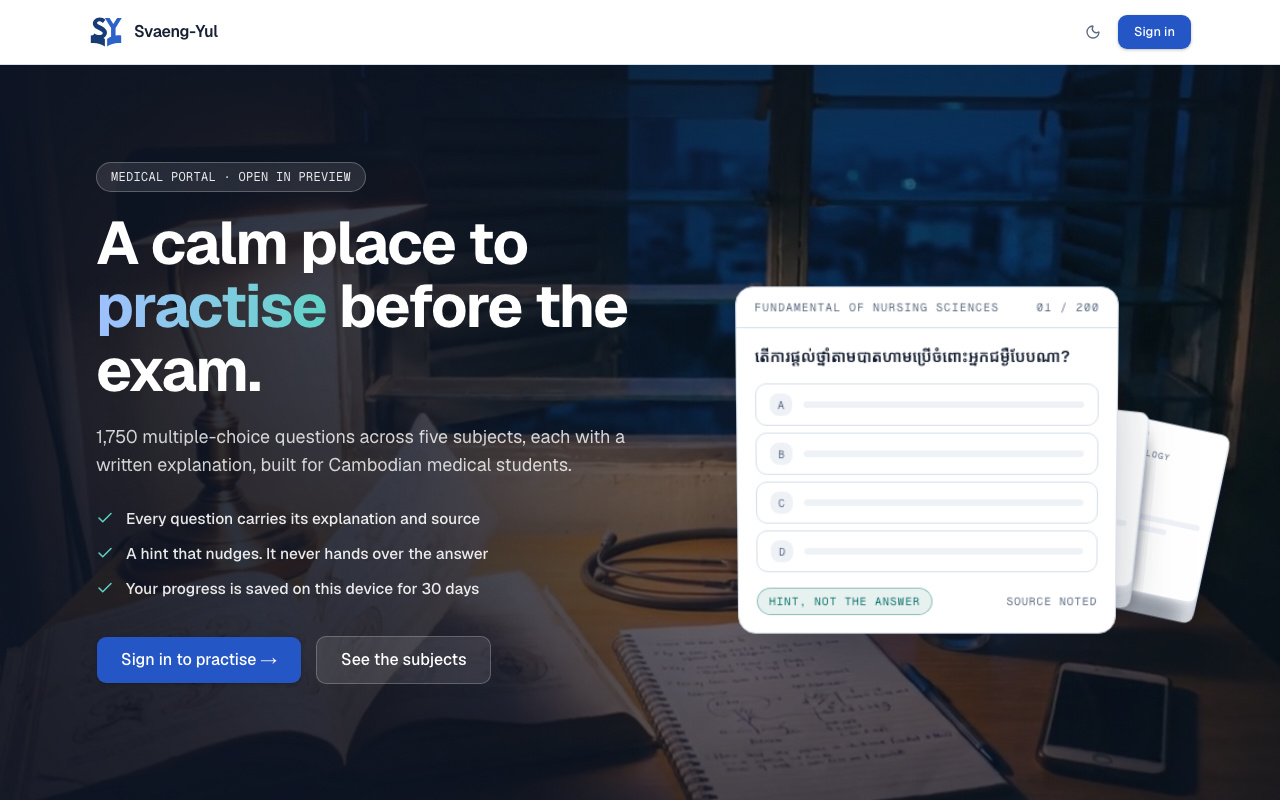
Many Cambodian students can find technical material in English but still lack a structured self-study path explained in Khmer. Svaeng Yul is a video-learning platform for AI engineering, data science, cybersecurity, and software engineering. It supports a credential-free demo and a real Supabase/Bunny deployment path through one codebase, while the launch candidate remains private until real infrastructure, Khmer content, legal review, and human checks are complete.
Proof- One typed data layer serves both a seeded in-memory demo and a Supabase-backed live mode, so the learner UI does not fork between environments.
- Tracks, courses, lessons, progress, profiles, and an admin publishing workflow form one complete learning-content model.
- The lesson assistant is grounded in the current transcript, rate-limited per user, optional by configuration, and never treated as the source of truth.
DeploymentPrivate launch candidate. The credential-free demo is verified locally; Supabase, Bunny Stream, Khmer production content, legal review, and staging evidence are still required before a public launch.
Next.js 16React 19TypeScriptTailwind CSS 4Supabase Auth+3
View case study →Public Demo + Private Operator2026Solo product design & engineering
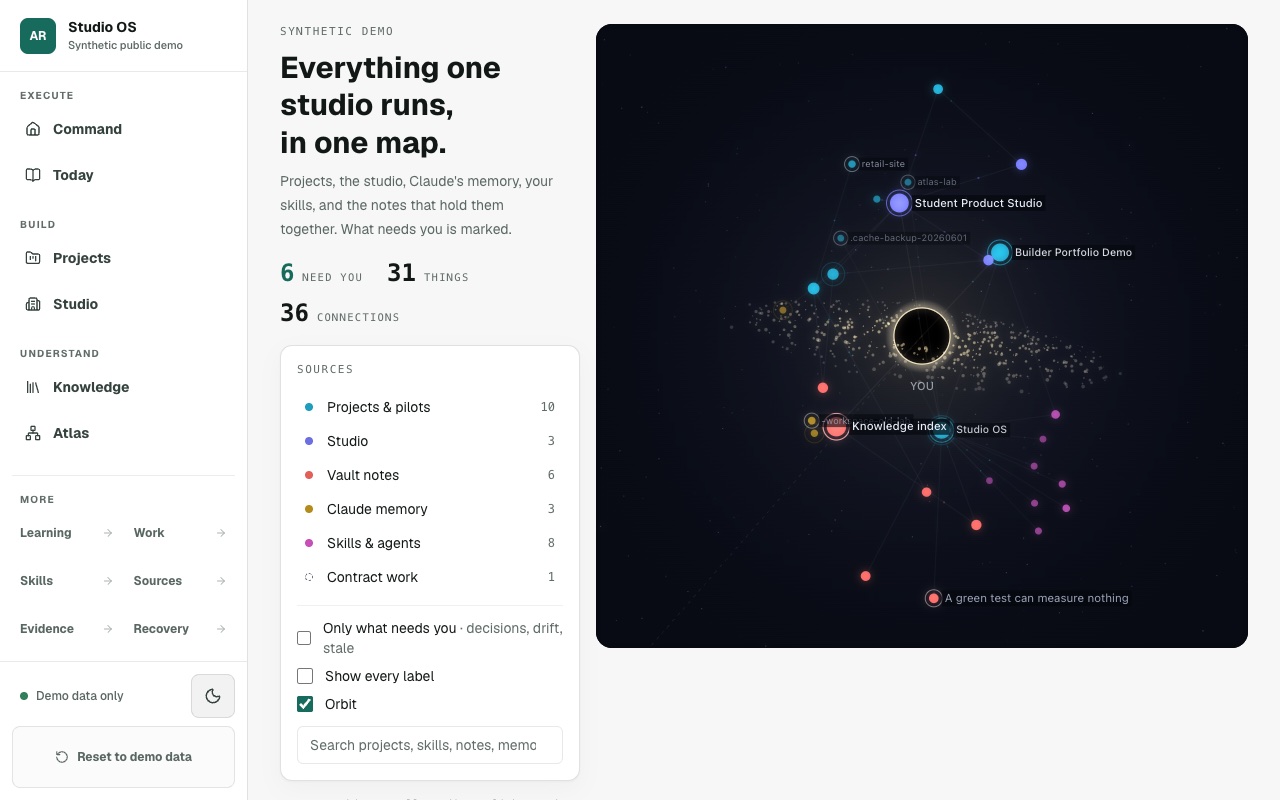
Studio OS is a personal command center built around two explicit operating modes and separate human and agent lanes. The public Vercel demo keeps neutral state in localStorage, uses synthetic connector data, and disables private workspace capabilities. The private operator adds bounded workspace retrieval and a read-only GitHub organization queue, then routes evidence through Inbox, Ready, Agent, Review, Blocked, and Done without transferring final authority from the human owner.
Proof- Bounded workspace retrieval inspects registered roots, shallow docs and manifests, package scripts, and Git state while excluding secret-like and generated paths.
- A read-only GitHub GraphQL adapter turns pull requests awaiting review, unassigned issues, and stale branches into an evidence-backed team queue.
- A shared Command Center separates human capture, agent preparation, review, blocked work, and accepted proof with R0-R3 routing signals.
DeploymentPublic demo on Vercel with neutral local state and synthetic connectors; private operator capabilities stay in owner-controlled source and require server-side access.
Next.js 16React 19TypeScriptTailwind CSS 4Base UI+3
View case study →Live Project2025Designer & Builder
A personal portfolio built as a real content system rather than a hand-coded page: every project, capability, and timeline entry lives in typed JSON that TypeScript composables read at build time, so copy stays separate from components. It proves I can structure a Nuxt 4 SSR app with a clean content model, ship production SEO (Open Graph, JSON-LD, sitemap), respect accessibility, and deploy to a custom domain on Vercel.
Proof- JSON-driven content model: projects, about, capabilities, and timeline live in content/*.json, read through typed composables against a Project interface — copy stays out of components.
- Production SEO on every route: per-page Open Graph + Twitter tags, canonical URLs, JSON-LD structured data, a sitemap route, and a robots.txt that references it.
- Accessibility handled deliberately: a skip link, a mobile-nav dialog with keyboard focus handling and Escape-to-close, and reduced-motion fallbacks.
DeploymentNuxt 4 SSR on Vercel, custom domain kavatana.me — no backend or database.
Nuxt 4Vue 3TypeScriptVanilla CSS@nuxtjs/sitemap+1
View case study →Local Learning Project2025Solo learner & builder
A local Python CLI workspace for practicing cybersecurity and CTF challenges in a structured, repeatable way. It turns scattered CTF notes into a tracked log of challenges, progress, and write-ups, and proves the ability to build a small CLI tool and organise technical learning systematically. Kept deliberately private and local-only — a security study habit, not a product.
Proof- Local Python CLI for CTF learning structure: tracks challenges, progress, and study notes from the terminal.
- Documentation-first workflow — structured note-taking and a personal security study log built as a repeatable habit.
- Private/local-only; not deployed. Runs on a single machine by design.
DeploymentLocal-only; intentionally not public.
PythonCLIShell scripting
View case study →Current study & build trackBackend Deployment Direction
I'm moving from frontend-only demos toward complete deployment systems: static frontends, API backends, hosted databases, environment variables, auth, storage, monitoring, and safe deployment workflows. My next study target is to deploy a backend API on Azure or AWS and connect it to a static frontend.
- Static frontend deploymentVercel / Azure Static Web Apps / AWS Amplify or S3 + CloudFront
- Backend API deploymentAzure App Service / Container Apps, or AWS App Runner / ECS / Lambda
- DatabasePostgres via Neon, Supabase, Azure Database for PostgreSQL, or AWS RDS
- StorageCloudflare R2, Azure Blob Storage, or AWS S3
- Operational basicsEnv vars, migrations, logs, health checks, rollback, and secret handling
Backend-adjacent proof I already have across these projects: Cloudflare Pages Functions, Express + Prisma APIs, Postgres, Neon, Supabase with row-level security, server actions, atomic transactions, and server-side scoring.